
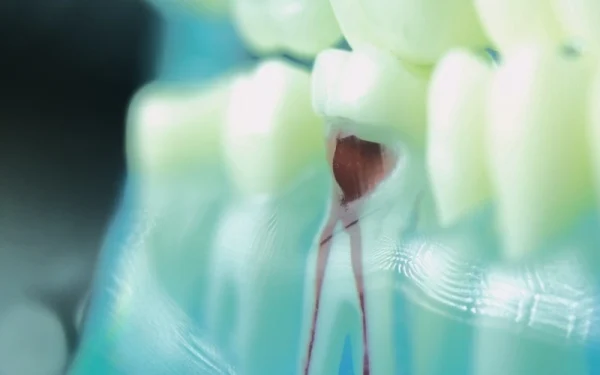
Root canal treatment, or endodontic treatment, might sound intimidating. But in reality, it’s one of the most effective ways to save a tooth from extraction. Before you go ahead, it’s worth knowing what the procedure involves and what to expect.
When is root canal treatment needed?
Root canal treatment is needed when standard fillings are no longer an option. This is the case when bacteria have reached the deeper layers of the tooth, causing pulp inflammation, periapical tissue infection, or gangrene.
How do you know if your tooth might need a root canal? There are a few signs to watch for. A lasting, intense toothache when you drink hot or cold beverages is one of them. Another is pain that gets worse in the evenings and at night, or when you touch or tap the tooth. Swelling of the tissue around the affected tooth is also a common sign.
Sometimes a tooth that needs root canal treatment causes no pain at all. The only warning sign may be a chronic periapical lesion visible on an X-ray. In this case the tooth is considered non-vital, which can be confirmed with an X-ray and a pulp vitality test.
Are there any contraindications?
There are no absolute contraindications to root canal treatment. Endodontics can be performed on patients of any age. Pregnant women can also undergo the procedure, since even in the event of complications, the risks are far lower than those posed by untreated acute dental infections. Many people are surprised to learn that root canals are also performed on children with baby teeth, for example after dental trauma or severe decay. In young children, however, the canals aren’t filled in the usual way, as this could interfere with the natural process of root resorption.
Patients with heart, kidney, or joint conditions, or those with a compromised immune system, carry a higher risk of complications. The procedure could trigger bacteraemia of dental origin, meaning bacteria entering the bloodstream and potentially affecting other organs. These patients usually receive a preventive course of antibiotics before and after treatment.
How does the procedure work?
Patients often ask how long root canal treatment takes and what it actually involves. The honest answer is: it depends. Some cases can be completed in a single visit, while others require several appointments. The complexity of the case and the number of canals in the tooth both play a role. Sixth molars, for example, often have four or even five canals, making them more time-consuming than seventh molars, which typically have just one or two.
Root canal treatment generally breaks down into five stages. The first is assessment, which includes an X-ray to understand the tooth’s structure and an intraoral examination using percussion and thermal tests to check whether the pulp is still alive.
Next comes preparation of the root canals. This means opening the pulp chamber and carefully cleaning out the pulp, which is where the bacteria causing the infection reside. If the pulp is still vital, the cleaning is done under local anaesthetic. The canals themselves also need to be cleared using specialist instruments. Equipment such as an endomotor to measure canal length and a cone beam CT scanner for a three-dimensional view can make the dentist’s job significantly more precise.
The third stage involves irrigating the root canals with chemical solutions, typically based on hydrogen peroxide and sodium hypochlorite. These solutions help clean the canals and prevent bacterial regrowth. In some cases, medication needs to be placed inside the canals over multiple appointments to fully treat the periapical tissue.
The fourth stage is filling the root canals. This needs to be done as carefully and tightly as possible to prevent bacteria from re-entering. Biocompatible materials are used, most commonly warm gutta-percha or gutta-percha points. The canals must be thoroughly dried before filling.
The final stage is a quality check using an X-ray. But the process doesn’t end there. Follow-up X-rays are recommended at 3, 6, and 12 months after treatment, and then every few years. This allows any changes in the tooth to be caught early and dealt with before they become painful.
Root canal treatment under a microscope
Dentistry has come a long way in recent years. Many modern practices now offer microscope-assisted root canal treatment. This approach not only reduces treatment time but also significantly improves success rates. The microscope gives the dentist a much clearer view of the tooth structure, allowing for more precise cleaning and filling of the canals.
Does it hurt?
There’s still a widespread belief that root canal treatment is painful. Older techniques certainly weren’t the most comfortable. Today, however, effective local anaesthesia means the procedure is virtually pain-free in most cases. Only rarely, when the infection is particularly severe, does the anaesthesia not work as well as expected.
Possible complications
Root canal treatment does carry a relatively higher risk of complications compared to some other dental procedures. During treatment, problems such as the following can occur:
- perforation of the canal
- instrument breakage inside the canal
- incomplete filling of a severely curved canal
- filling material being pushed beyond the root apex
After treatment, some patients experience ongoing pain. Your dentist may recommend painkillers or antibiotics in this case. Pain following root canal treatment is often caused by a periapical lesion that hasn’t healed, or by a small amount of pulp tissue left behind in the canal. In some cases the treatment needs to be repeated, ideally under a microscope. In rare situations, when endodontic treatment doesn’t achieve the desired result, extraction may be the only option.
How much does root canal treatment cost?
Root canal treatment is one of the more expensive dental procedures. The price depends on the reputation of the practice, the experience of the dentist, and the location. Prices for treating the same tooth can vary considerably between different practices.
As mentioned earlier, not all teeth have the same number of canals. More canals mean more work for the dentist, as each one needs to be cleaned individually. For this reason, the cost of root canal treatment depends in part on how many canals the tooth has. You can find more details about our pricing in our price list.
Root canal treatment is a real opportunity to save a tooth from extraction. That said, it’s always worth trying to avoid getting to that point in the first place. Good oral hygiene and regular dental check-ups make all the difference.