
Wisdom teeth don’t grow in everyone. When they do appear, they often come with a question: do they need to come out, or is it better to leave them?
There is no single right answer, because everything depends on the individual case. In this article we explain when wisdom teeth should be removed and why they grow in the first place.
Why do wisdom teeth grow?
Wisdom teeth are teeth whose growth is slowly disappearing in human evolutionary development. This is driven by evolution and changes in our eating habits.
In the past, people had to bite and chew large quantities of raw food, so extra molars were extremely useful.
Today, when most of what we eat is heavily processed, molars no longer play the same important role they once did. They are still coded in the genetics of many of us, however, and they tend to surprise us by appearing in the jaw most often between the ages of 17 and 25.
In some cases they can even emerge after the age of 40. Wisdom teeth often have quite an unusual shape compared with other teeth, as well as an odd number of roots.
Do wisdom teeth need to be removed?
Since wisdom teeth no longer serve any real purpose in our dentition today, many of us wonder whether it is better to have them out.
According to experts, if these teeth are not causing you any trouble at all, there is absolutely no need to remove them. What do we mean by “trouble”?
- teeth that don’t fit in the dental arch and press on the other teeth,
- impacted teeth,
- teeth affected by decay.
In some people the very process of wisdom teeth coming through causes severe pain and leads to serious problems with the bite. This happens because the jaw of modern humans is much smaller than that of our ancestors.
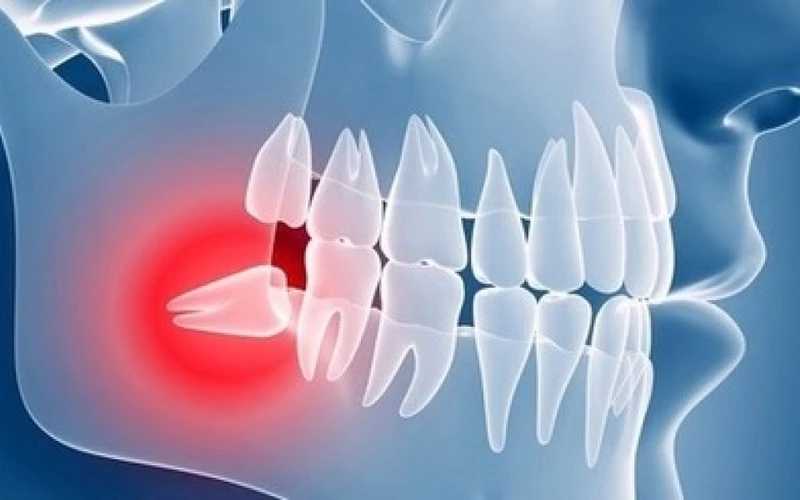
Wisdom teeth can simply run out of space, pressing on the surrounding teeth and even causing crowding and shifting. On top of that, it is common for wisdom teeth not to fully erupt. This is known as an impacted tooth, where the tooth remains partially or entirely within the gum.
The cause is usually an incorrect position of the wisdom tooth within the bone. This brings with it severe pain in the temporomandibular joint, and often headaches and inflammation caused by bacteria and food debris collecting under the gum flap. In such cases, extraction is carried out as a preventive measure, to eliminate potential sites for cysts, reduce the risk of jaw fractures, and prevent resorption of neighbouring teeth. Wisdom teeth that are affected by decay also qualify for removal.
Wisdom teeth sit at the back of the jaw, in a spot that is quite difficult to clean properly, which makes them prone to bacterial build-up and inflammation. Their location also makes them difficult to treat, so extraction is often the best solution in such situations.
It is also worth bearing in mind that while wisdom tooth extraction is one of the most commonly performed dental procedures, it is a demanding one with a relatively higher risk of complications. These complications relate to the variable anatomy and positioning of the additional molars. Removal of a wisdom tooth can involve pain, swelling, or even trismus.
When wisdom teeth are worth keeping
If your wisdom teeth are not causing any problems at all, it is certainly worth keeping them. They are fully functioning teeth and provide additional support for the other molars.
Wisdom teeth can also prove useful in the future – for example as a prosthetic abutment, supporting the connection between a crown and an artificial tooth root. There is also a possibility that future dentistry may offer wisdom tooth transplantation into the sites of lost molars. Dentistry is currently in the experimental stages of this kind of work.
The decision about whether to remove wisdom teeth should never be made alone. Ask your dentist for advice. Leaving wisdom teeth that are not causing any problems certainly won’t do any harm, and in the future could even prove very useful – so there is no need to rush into anything.