
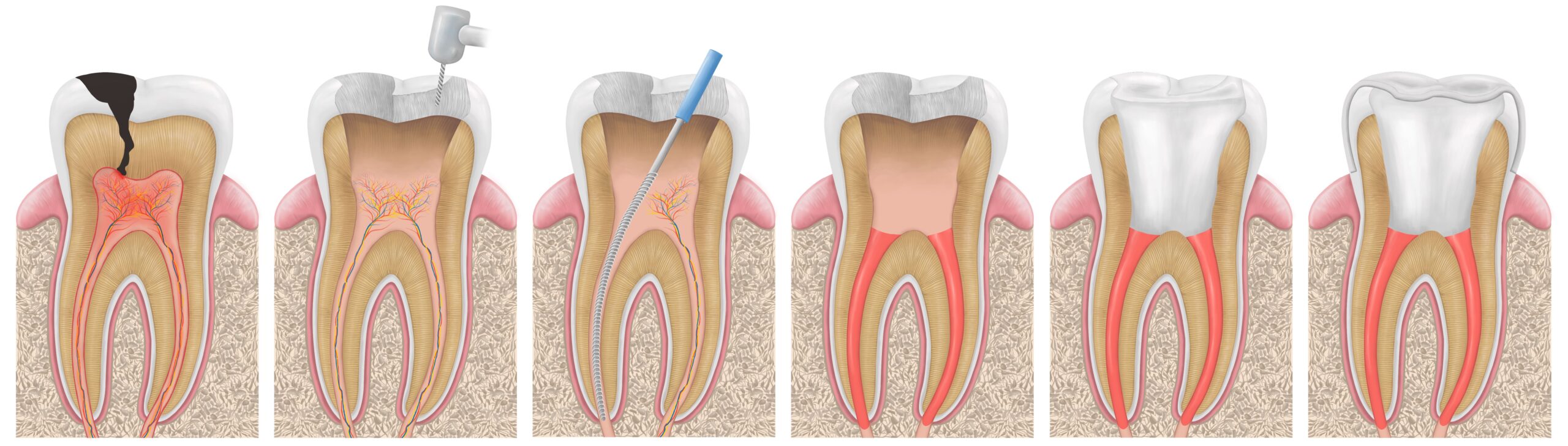
Every tooth has more than just its visible part — the crown. Hidden deep inside is the root canal. That is where disease can develop, and without the right treatment, it can cause serious problems for patients. People often ask whether root canal treatment is painful and what the procedure actually involves. We hope this article gives you clear answers.
What is root canal treatment?
Root canal treatment, also called endodontics, is a procedure that removes diseased or dead pulp from inside the root canal. The pulp is the soft tissue at the centre of a tooth, containing nerves and blood vessels. When bacteria attack it — due to deep decay or injury — inflammation can set in. Without proper treatment, this leads to abscesses, pain and, eventually, tooth loss.
The procedure involves thoroughly cleaning the root canals, disinfecting them and filling them with a special material. The goal is not just to remove the source of infection, but to restore the tooth’s stability and function for years to come.
Stages of root canal treatment
Endodontic treatment is not a single step. It is a multi-stage process designed to treat the tooth effectively. The first step is diagnosis. We use an X-ray to assess the condition of the tooth and the shape and number of root canals. This lets us plan the next stages carefully.
Once we know the tooth’s anatomy, we move on to anaesthesia. This is what makes the procedure comfortable and completely pain-free. We use modern anaesthetic agents that effectively eliminate any discomfort.
Next comes canal cleaning. This stage of endodontic treatment aims to:
- remove the remaining pulp tissue from inside the canal,
- eliminate micro-organisms that could cause infection,
- remove dentine filings produced during treatment,
- shape the canal so it can be thoroughly cleaned and filled.
During cleaning, preserving the original shape of the canal is important. The physiological opening must remain intact. Ideally, the canal should narrow from the coronal section to the apical section, ending at the apical constriction. Throughout the whole process, generous amounts of irrigating solutions are needed, and the original working length of the canal must be maintained.
After cleaning comes disinfection. We use antibacterial preparations to eliminate any remaining bacteria and protect against re-infection.
Once the canals are clean and healthy, we fill them with a special material to seal them. The filling secures the tooth against re-infection and restores its function. The material must precisely fill the root canal to prevent secondary infection, and it must not shrink or expand after placement.
A well-chosen canal filling material is a combination of a semi-solid material and a sealer. The semi-solid material forms the main body of the filling and gives it structure. The sealer fills any microscopic spaces between the semi-solid material and the canal walls, ensuring a complete seal and leaving no hiding places for bacteria.
The final stage is tooth restoration. Depending on the extent of damage, this may be a composite filling, an inlay or a crown. The tooth then regains its natural shape and appearance.
Does root canal treatment hurt?
Modern root canal techniques, combined with advanced anaesthesia, mean that the procedure itself is practically painless. Patients are often surprised by how comfortable they feel during treatment. Of course, a few factors can influence pain perception — such as existing inflammation or infection near the root — but proper anaesthesia keeps these well under control. After the procedure, some patients may feel mild discomfort or soreness, but this is usually short-lived.
Summary
Root canal treatment is a dental procedure carried out in safe, controlled conditions. Its main purpose is to save a tooth that would otherwise be lost. Thanks to advanced techniques, modern instruments and excellent materials, the treatment is effective and practically painless.