Although dental implants are far from new in the world of medical procedures, they still raise many questions among patients facing the decision of whether to go ahead. Many people worry about a seemingly complicated procedure and the not-insignificant cost – but are these really reasons to say no?
Here is a complete guide to dental implants that should make the decision a little easier.
What are dental implants?
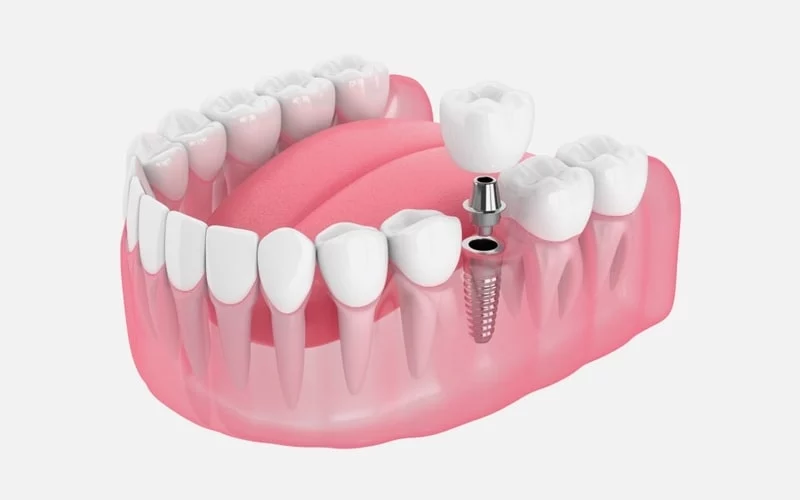
A dental implant is a small screw made from ceramic or biocompatible metals. Its job is to replace a missing tooth root and act as a support for crowns, bridges, or full dentures.
Today, dental implants combined with a prosthetic crown are widely regarded as the best solution for replacing a lost tooth. They are an excellent alternative to conventional prosthetics.
Patient satisfaction with dental implants is very high.
According to a survey of 10,000 German patients (Riegl), as many as 67% described themselves as “very satisfied” and 31% as “satisfied” with their dental implants. By comparison, only 42% said they were “very satisfied” and 44% “satisfied” with conventional prosthetic solutions.
The risks of dental implants
Patients often wonder whether dental implants are a safe and minimally invasive procedure and what risks might be involved. Dental implants have been used by dentists around the world since the 1960s. Back then, implants made from pure titanium were the common practice.
Today’s dental implants are far more technologically advanced and continue to serve successfully as artificial tooth roots. Modern implants feature special nanostructures that interact with the jawbone, accelerating integration and providing a more stable fit and greater durability.
The integration rate for the leading implant systems is currently estimated at 98.9% of all implant procedures performed. That said, implant surgery – like any surgical dental procedure – does carry certain potential risk factors, which vary from patient to patient.
The success of implant treatment can be affected by factors such as impaired wound healing caused by existing medical conditions, or even poor oral hygiene. In extreme cases, the body may reject an implant. Your dentist is best placed to assess the risks during the consultation, though complications after implant placement are rare.
Who are dental implants suitable for?
There are certain age restrictions when it comes to implant treatment. Dental implants cannot be placed while the jawbone is still developing, so they are only suitable for younger patients whose bones have already stopped growing.
There is no upper age limit, however. Contraindications to implant treatment are various medical factors, always assessed by the dentist before any decision is made.
Today, even patients with well-controlled diabetes or cancer can be considered for dental implant treatment.
People with periodontal disease will need to complete periodontal treatment first. Those who have experienced partial bone loss due to prolonged inflammation will need a preparatory phase involving bone regeneration, alveolar ridge splitting, or sinus floor elevation.
The benefits of dental implants
There are many advantages to dental implants. What are the main ones?
- Preventing unwanted changes in the mouth – extracting a tooth and leaving a gap for a prolonged period leads to bone loss (resorption). This can cause the surrounding teeth to tilt or drift. Placing an implant effectively prevents these unwanted changes.
- Comfort for the patient – most people have heard stories from denture wearers about instability or even dentures falling out. People with dental implants don’t have these problems. Implants provide a solid, stable foundation for crowns, bridges, and dentures, greatly increasing comfort.
- Invisibility – implants are placed below the gumline and are practically invisible. The crowns or dentures fitted on top closely mimic natural teeth, so patients don’t need to worry about changes to their appearance.
How implant treatment works
Placing the implant itself is done in a single appointment. The procedure is carried out under local anaesthetic and is often less invasive than, for example, wisdom tooth removal.
Implant treatment generally takes place in four stages:
- Diagnosis – the dentist takes a full medical history, looking for any conditions that might contraindicate implant treatment. At this stage they assess whether the procedure is feasible and what risks might be involved. A CT scan is also taken for a more detailed picture of any limitations. It is possible that the bone where the implant is to be placed has already partially resorbed due to a long-standing gap. In that case, bone augmentation will first be needed to restore bone volume and ensure the implant will be stable.
- Implant placement – the implant is fixed into the bone. It can be fitted with a healing cap or a temporary tooth, creating conditions that allow the gum to heal freely.
- Healing – after placement, the implant undergoes osseointegration, fusing with the bone. This process can take up to 6 months. After this the implant has the stability needed for the next stage. Sutures are removed around a week after the procedure. Good oral hygiene and following the dentist’s instructions play a major role during healing. Right after surgery the area should be cooled to prevent swelling and minimise pain. Pain relief medication may be needed if discomfort is significant. During the first few hours after the procedure you should avoid rinsing your mouth, as this can cause bleeding. During healing it is also important to avoid chewing hard foods, intense physical exercise, coffee, black tea, alcohol, and smoking. The area around the implant should not be brushed until the sutures are removed.
- Final restoration – while healing is underway, an individual tooth is prepared in the prosthetic laboratory. Once healing is complete, it simply needs to be secured to the implant.
Which material should you choose for dental implants?
Choosing the material for dental implants is something patients often find tricky. The choice is usually between titanium and ceramic implants.
Titanium is a biocompatible material, meaning it is well tolerated by the body and shows no toxicity. Titanium implants have been used in medicine for many years and not a single case of allergy to the material has ever been recorded. Titanium implants are highly durable (they can last several decades) and fuse with bone easily.
Ceramic implants are also highly durable, and they offer better aesthetics. If you have thin gums there is no need to worry about the implant showing through with a greyish tint, as can sometimes happen with titanium implants.
Caring for dental implants
Dental implants, like natural teeth, need proper care. Their longevity depends largely on how well they are looked after. The implant is protected from infection by the surrounding gum tissue.
If you don’t brush regularly and thoroughly, allowing plaque to build up, the bacteria in it can cause gum inflammation around the implant – a condition known as peri-implantitis. This chronic inflammation can lead to bone loss and ultimately implant failure.
Implants also need regular dental check-ups and professional cleaning. This is recommended twice a year.
Are dental implants worth the cost?
Implant treatment can run to several thousand pounds, so it’s worth considering the long-term gains that come with dental implants.
Research shows that the cost of a single implant-supported restoration pays for itself within 7 years, and the long-term maintenance costs of implants are lower than those of a conventional bridge. A single implant can therefore be more financially advantageous for replacing a single missing tooth than a traditional, permanently cemented three-unit bridge.
Implants are particularly worthwhile when there is enough bone available for placement. The considerably better quality of life that dental implants offer, compared with traditional prosthetic options, is something many patients consider priceless. Dental implants are a personal decision for every patient, made with guidance from their dentist.
Before making that decision, it’s worth being well informed about what the process involves, so you can decide with full confidence. Better knowledge also tends to mean less anxiety before the procedure.