
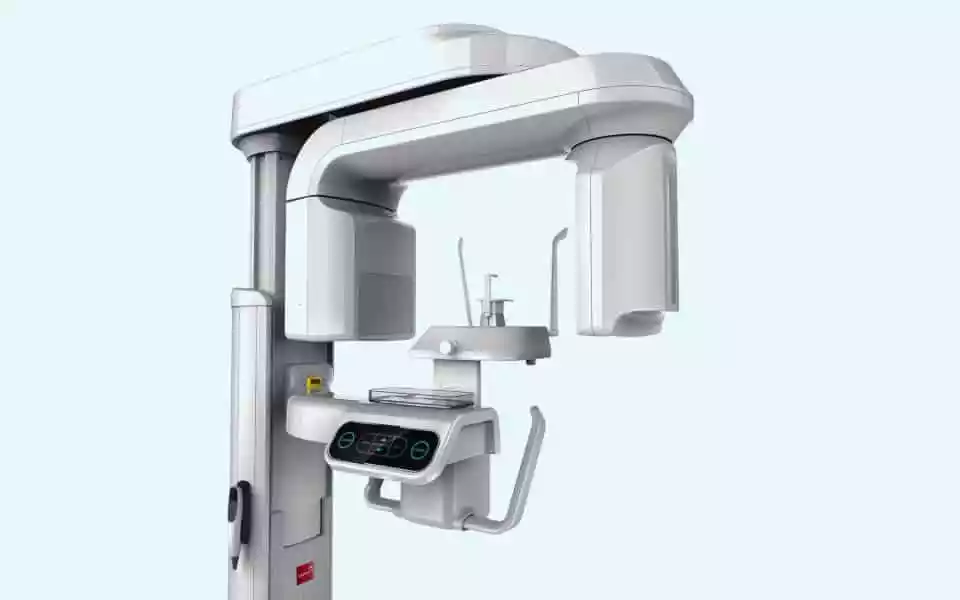
Professional dental treatment often relies on imaging to diagnose conditions that aren’t visible to the naked eye. A panoramic X-ray, cephalometric image, and standard dental X-ray are all commonly used tools, but there’s another imaging method that offers something none of these can match: 3D dental CT scanning. Let’s take a look at what it involves and when it’s used.
What is a dental 3D CT scan?
A dental 3D CT scan (also known as a CBCT scan, from Cone Beam Computed Tomography) is a specialist imaging study that produces highly detailed three-dimensional images of the teeth, jawbones, and surrounding structures. Unlike a standard dental X-ray, which gives a flat, two-dimensional image, a CBCT scan shows the structures of the head in three dimensions and from multiple angles. This gives the dentist a far more complete picture and allows for much more precise planning of complex treatments.
The scan can be used to examine the upper jaw (maxilla), the lower jaw (mandible), a specific section of the dental arch, or the temporomandibular joints (TMJ). It’s performed by specialist dental radiology centres and by some dental practices that have their own CBCT equipment.
When is a dental CT scan ordered?
Your dentist may order a CBCT scan in a range of situations:
- Implant planning — to assess the exact volume and density of available bone before placing an implant, and to map the position of important anatomical structures such as nerves.
- Endodontics — to get a precise picture of complex root canal anatomy before or during root canal treatment.
- Orthodontics — to evaluate the position of unerupted or impacted teeth and plan their movement.
- Oral surgery — for planning the removal of impacted wisdom teeth or other surgical procedures.
- Trauma — to assess jaw fractures or other injuries to the bones of the face.
- Diagnosis of jaw joint problems — to examine the temporomandibular joint for signs of arthritis or structural problems.
- Detecting pathology — to identify cysts, tumours, infections, or other abnormalities in the jawbone or surrounding tissue.
How is the scan done?
The procedure is straightforward and non-invasive. You sit or stand in the scanner, which rotates around your head, taking a series of images. The whole process takes only a few seconds to a couple of minutes. You don’t need to do anything other than stay still. There’s no discomfort, and nothing enters your body. You’ll usually be asked to remove any metal jewellery, glasses, or hearing aids before the scan, as these can interfere with the images.
Is the radiation dose safe?
Any dental or medical X-ray involves exposure to ionising radiation. The radiation dose from a CBCT scan is higher than a standard dental X-ray but significantly lower than a full-body medical CT scan. Dentists follow the ALARA principle (As Low As Reasonably Achievable) and only order CBCT scans when the clinical benefit clearly outweighs the risk. Most patients who have a CBCT scan will only ever need one, or at most a small number, in their lifetime.
What happens with the results?
Once the scan is complete, the images are processed into a 3D model that your dentist can view and manipulate on a computer screen. The dentist can examine the structures from any angle and take precise measurements. This makes it possible to plan procedures with a level of accuracy that simply isn’t achievable with conventional X-rays alone.
The 3D CT scan has become an invaluable tool in modern dentistry. If your dentist recommends one, it’s because having that level of detail will help them provide you with the safest and most accurate treatment possible.