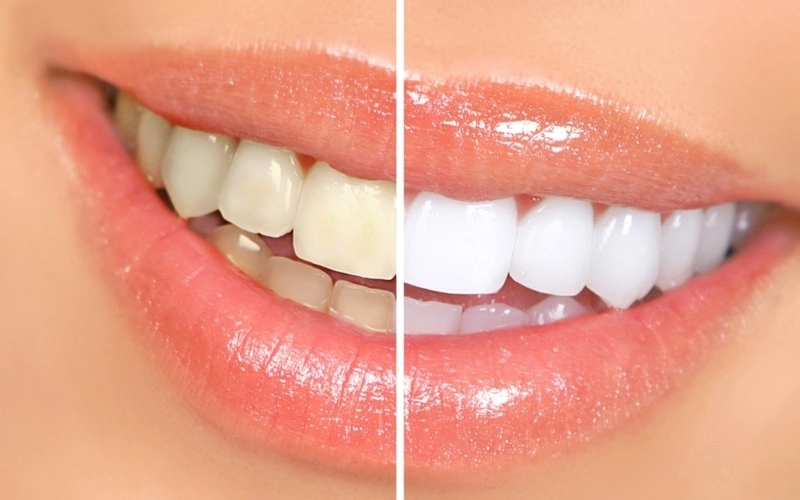
White teeth are something many people dream about. There are also plenty of ways to go about whitening teeth. In this article we take a closer look at two of them: modern Beyond lamp whitening and traditional tray whitening. Read on for a comparison of how the two most popular smile-brightening treatments work and what results they achieve.
Teeth whitening – when is it possible?
First of all, it is worth noting that whitening is not always possible. Both Beyond lamp whitening and tray whitening cannot be carried out for:
- pregnant women,
- breastfeeding women,
- anyone under 18,
- people with untreated tooth decay,
- people with unremoved tartar.
In addition, for reasons related to the effectiveness of the treatment, whitening is not recommended for smokers who are unable to give up smoking during the course of treatment and for one week after it ends.
Preparing for teeth whitening
Teeth whitening must be preceded by proper preparation. What does that involve?
- treating the teeth – before planned whitening, the teeth need a thorough check-up. Any decay must be removed, cavities filled, and root canal treatment carried out where necessary. This is to prevent the whitening agent from penetrating the dentine, where it could cause serious damage to the tooth.
- removing tartar – for whitening to produce good, even results, the teeth must be free of tartar. Scaling and air polishing will take care of that.
Tray whitening – how does it work?
It is worth mentioning that tray whitening, despite the constant refinement of dental techniques, remains a traditional and popular choice for patients who want to improve the look of their teeth. How does this method work?
Tray whitening starts with a visit to your dentist, who takes impressions using impression trays. Based on the plaster casts, a technician makes two clear aligners, known as trays, one for the upper teeth and one for the lower teeth. The impressions are taken so that the trays fit closely against the patient’s teeth. At the second visit, the patient tries on the trays to check they fit correctly and receives syringes filled with whitening gel. The concentration of the whitening agent is chosen individually, taking into account the patient’s sensitivity and the desired results.
Everything after that is done by the patient at home. Following the dentist’s instructions, they carry out the treatment with the gel and trays over a period of two to four weeks. The variable duration reflects the fact that a lower concentration of whitening agent requires a longer contact time with the teeth.
Home treatment involves applying whitening gel to the inside of the trays and wearing them every day for a set amount of time. This is usually 4 hours a day, though the dentist may recommend wearing them for 8 hours overnight.
Beyond lamp whitening – how does it work?
Beyond lamp whitening is one of the most advanced whitening methods offered by modern cosmetic dentistry. It is an excellent choice for patients who want a fast and dramatic change in tooth shade. One reason it delivers such impressive results is that the treatment removes stains from deep within the tooth structure, not just surface-level staining as tray whitening does.
A special whitening gel is also used in Beyond lamp whitening. The pH of the gel matters – it is usually matched to be close to the natural pH of the patient’s mouth, which prevents enamel damage. Once the whitening gel is carefully spread over the teeth, its active ingredients are activated by the Beyond lamp, which emits so-called cold light that is completely safe and harmless.
The whole treatment usually takes around 40 minutes, and the results are visible immediately. Patients don’t experience any pain during the procedure.
Results of tray whitening and Beyond lamp whitening
The results of tray whitening depend largely on the patient’s self-discipline and diligence. If the whitening gel is applied unevenly in the trays, or the trays are used inconsistently or for shorter than the recommended time, the results may be disappointing and could even make the appearance of your teeth worse.
Following the dietary guidelines during whitening and for at least one week afterwards is also very important. You should stick to what is called a “white diet” – avoiding staining drinks such as strong tea, coffee, red wine, and fruit juices, as well as foods that could discolour the teeth, such as blueberries and beetroot.
Smokers must absolutely refrain from smoking during this time, as cigarettes can yellow the teeth even more visibly than before whitening. That said, tray whitening carried out with proper care can lighten teeth by up to 6 shades, with results lasting 2–3 years. For this reason, many dentists acknowledge that the results of tray whitening are comparable to other, more modern whitening techniques.
After completing tray whitening you may find that old, stained composite fillings don’t blend well with the newly whitened teeth, meaning they need replacing. Bear in mind, though, that any replacement should not be done sooner than 3 weeks after finishing treatment, as tooth colour is still stabilising during that time and replacing them too soon can cause a shade mismatch.
With Beyond lamp whitening, things are far simpler, as nothing depends on the patient – everything is handled by your dentist. The result depends solely on the dentist selecting the correct pH of the whitening gel, to avoid damaging the enamel while still delivering a clearly visible change in shade.
With this method, teeth can lighten by up to 14 shades, and results will also last 2–3 years after treatment. A white diet must also be followed for one week after a Beyond lamp whitening session.
After either whitening method, it is recommended to use a specialist toothpaste that removes current staining, helping to prolong the results of treatment.
Possible side effects of teeth whitening
Tray whitening is regarded as a tried-and-tested, safe whitening method, given the low concentration of whitening agents in the gel used. Side effects are rare, though some patients do experience sensitivity to cold or hot food and drinks. This can usually be resolved by using a toothpaste designed for sensitive teeth.
If you already have sensitive teeth before starting tray whitening treatment, let your dentist know so they can choose the right product. Newer-generation products contain an ACP formula – Amorphous Calcium Phosphate – which both rebuilds enamel and reduces tooth sensitivity.
For example, the formula used in popular Opalescence products is based on carbamide peroxide, fluoride, and potassium nitrate, which effectively reduces tooth sensitivity.
Beyond lamp whitening is also considered safe. Some patients experience tooth sensitivity after the treatment, but this is a normal response to the rapid whitening process and usually settles within 24 hours.
Tray whitening vs lamp whitening – cost
There’s no denying that tray whitening is a much more affordable way to improve the look of your teeth than the Beyond lamp method. This is certainly one reason why tray whitening is more popular, though lamp-based treatments can compete on the speed of results.
When choosing between tray whitening and Beyond lamp whitening, the key question to ask yourself is: what results do you want, and how quickly do you want them?
If you want faster, more dramatic whitening and a higher cost isn’t a concern, the modern Beyond lamp whitening method is well worth considering.