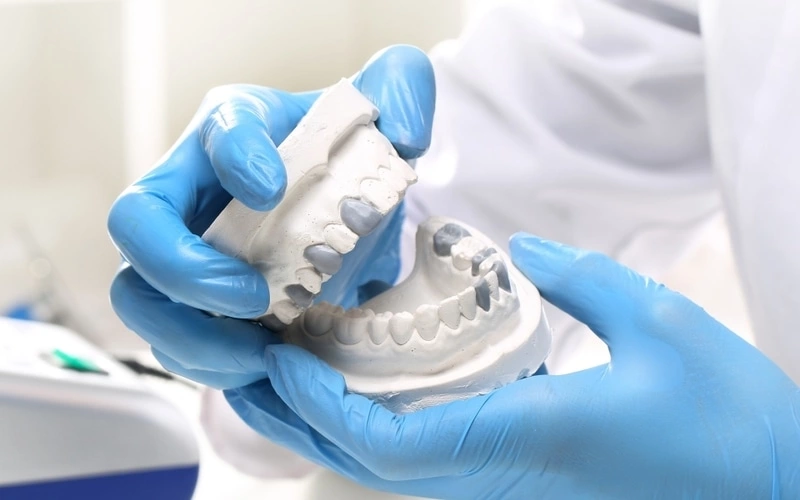
Prosthetic treatment is one of the options offered to patients with missing teeth. Although the decision seems straightforward, choosing the material for the denture can cause confusion. To make that choice easier, this article compares the two most popular types of denture – the acron denture and the acrylic denture.
Acron vs acrylic – what is the difference?
Porcelain crowns are the most commonly used type of crown. As the name suggests, they are made from porcelain, which is comparable in durability to natural teeth, though slightly less durable than metal crowns. If aesthetics matter more than durability, particularly for front teeth, porcelain crowns are the ideal choice. They are a permanent restoration that replaces the natural crown of a tooth that has been significantly damaged for various reasons or removed when a tooth was extracted.
A veneer, on the other hand, is a thin porcelain plate – roughly half a millimetre thick – that is bonded to the natural tooth to correct aesthetic issues such as discolouration, chips, or misalignment. Because these issues are most noticeable on teeth visible when smiling, veneers are most commonly placed on front teeth. Both materials are matched for shade and shape so that the result looks like natural teeth.
Acron vs acrylic dentures – what is the difference?
An acrylic denture is the most popular type of dental denture. Most of us have seen one at some point – perhaps with a grandparent or parent. An acrylic denture can be removable or permanently fixed. An acron denture, on the other hand, is a newer development in prosthetic treatment, and it has quickly gained a lot of positive feedback.
The main difference between an acron and an acrylic denture is flexibility. While an acrylic denture is completely rigid, an acron denture belongs to the category of thermoplastic dentures. It also has a noticeably thinner profile than an acrylic denture.
Patients with a completely edentulous mouth do not have a choice between acron and acrylic, however – an acron denture requires at least three healthy teeth to be present in the mouth.
Acron dentures – pros and cons
The biggest drawback of an acron denture is that it cannot be used by patients with no remaining teeth. The relatively higher cost is offset by significantly better comfort during wear. The clear advantages of an acron denture include:
- flexibility – an acron denture moulds to the oral mucosa, preventing soreness and irritation, and patients find it much easier to adapt to wearing it.
- comfort – many patients really appreciate how comfortable an acron denture is to wear. Putting it in does not create a feeling of fullness in the mouth or trigger a gag reflex.
- aesthetics – an acron denture has transparent clasps, so it does not disturb the natural colour of the gums and is practically invisible.
- better mechanical durability – compared with acrylic dentures. Acron dentures do not break.
- good longevity – acron dentures do not warp or change colour even after several years of use or as a result of eating hot food.
- better hygiene – acron dentures do not absorb water, so unlike acrylic dentures they very rarely contribute to the development of oral thrush.
Acrylic dentures – pros and cons
An acrylic denture is a tried-and-tested solution with many fans. Its biggest advantage is its low cost – and for patients who qualify for reimbursement, no cost at all. An acrylic denture is a recommended option particularly for the upper jaw. An upper acrylic denture, thanks to its fairly large surface area in contact with the mucosa, works like a suction cup and tends to be far easier to adapt to and use day-to-day than a lower acrylic denture. The lower price of an acrylic denture reflects its downsides, which include:
- difficulty adapting – an acrylic denture is a rigid, hard foreign body, so the adaptation process can be quite troublesome. During the adjustment phase, the patient’s speech may be unclear, there may be a tendency to hold the mouth in an unnatural position, and irritation of the oral mucosa may occur. Placing the denture can also trigger a gag reflex.
- rapid water absorption of acrylic – this brings not only the risk of fungal infections in the mouth but also reduced stability, particularly with a full lower acrylic denture.
- risk of inflammation – if the denture is placed incorrectly or oral hygiene is poor, an acrylic denture can contribute to inflammation.
- possible colour change – also linked to poor hygiene. An acrylic denture can become dull or take on a pinkish-brown or pinkish-yellow tinge in smokers or in people who drink large amounts of strong tea or coffee.
Acrylic and acron dentures – prices
While the choice of the best denture should be based on the pros and cons of each option, it’s no secret that cost matters to many patients too.
An acron denture costs £700, regardless of how many teeth it needs to replace. And if you lose another tooth, there is no need to order a new denture – an artificial tooth can simply be added to the one you already have.
The cost of an acrylic denture is £400 for a partial denture or £500 for a full denture.
Making a dental denture
The process of making both acrylic and acron dentures is very similar and usually takes a few weeks. At the first appointment, the dentist takes a full medical history and carries out a clinical examination, which allows them to recommend the best course of treatment. If the patient decides to go ahead with prosthetic treatment, an impression of the mouth is taken to capture its shape and allow a well-fitting denture to be made. Taking a good impression is an important step in the process, as the accuracy of the impression determines how comfortable the denture will be to wear. The impression is sent to a laboratory, where a trial wax denture is made. This is sent back to the dentist, who fits it at the patient’s next appointment to check the fit, identify any adjustments needed, and establish the correct bite height. Only then does the dental technician produce the final denture from the patient’s chosen material and send it back to the dentist.
The choice of dental denture deserves careful thought and a consultation with your dentist. It is difficult to say definitively which denture is the best, as a great deal depends on the patient’s preferences, gum sensitivity, and commitment to hygiene and proper use. When faced with the choice, though, it is well worth considering both options discussed here.